
How to lower taxable income with charitable giving
Are you wondering how you can save on taxes while giving more to charity? As you reflect on your 2025 tax bill, it’s an ideal time to consider your charitable, financial, and tax planning for 2026.
To help you start your planning, this article answers three questions:
1. What tax rules affect charitable giving in 2026?
2. What are some charitable giving strategies that can be used to reduce taxes?
3. Why is a donor-advised fund (DAF) a tax-smart way to give to charity?
You’ll walk away with ideas on how to pay less in taxes and have more money to give to charity, whether you choose to itemize deductions or take the standard deduction for your 2026 taxes.
Download a PDF of this article
The subsidiaries and affiliates of The Charles Schwab Corporation and DAFgiving360 do not provide specific individualized legal or tax advice. Please consult a qualified legal or tax advisor where such advice is necessary or appropriate.
What tax rules affect charitable giving in 2026?
Two new rules for itemizers
Under the One Big Beautiful Bill Act (OBBBA), only aggregate charitable contributions that exceed 0.5% of your adjusted gross income (AGI) will be deductible. If your AGI is $300,000, for example, you can deduct any contributions in excess of $1,500 ($300,000 x 0.5 %).
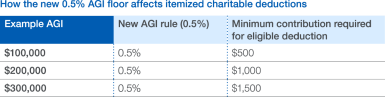
Additionally, if you’re in the 37% income tax bracket (over $640,600 for single filers or $768,700 for married couples filing jointly), the OBBBA caps the value of your itemized deductions, including charitable deductions, at 35%.
Charitable deduction limits for itemizers
Overall deductions for contributions to public charities, including DAFs, are generally limited to 50% of your AGI. The limit increases to 60% of AGI for cash contributions. For appreciated non-cash assets held more than one year, the limit is 30% of AGI.
If your charitable deduction exceeds your AGI limit in 2026, you can carry the excess deduction amount forward in up to five additional tax years (while still staying within your AGI limit for each year).
Standard deduction amounts for non-itemizers
Itemizing deductions makes sense if your total itemized deductions exceed the standard deduction. For 2026, the standard deduction amount is $16,100 for single filers and $32,200 for married couples filing jointly.

If you’ll take the standard deduction for your 2026 taxes, the OBBBA allows you to deduct an additional amount for your cash contributions to qualified operating charities: up to $1,000 if you’re a single filer or $2,000 if you’re a joint filer. Note that a DAF is not an operating charity, so the charitable deduction can’t be used for DAF contributions.
Read about tax law changes
What are some charitable giving strategies that can be used to reduce taxes?
1. Potentially eliminate capital gains taxes by donating appreciated non-cash assets
You may have stock shares, real estate, crypto, or another non-cash asset that has gained a lot of value relative to your original cost. While you could sell the asset and give cash to charity after the sale, donating an appreciated non-cash asset held more than one year is tax-smart and can unlock additional funds for charity in two ways:
- First, you potentially eliminate the 15% or 20% capital gains tax you would incur if you sold the assets and donated the proceeds, which may increase the amount available for charity by up to 20%.
- Second, you could potentially claim a fair market value charitable deduction for the tax year in which you make the gift, assuming you itemize (donation deduction is subject to certain AGI limitations).
About donating non-cash assets
2. Offset unexpected income with a charitable contribution and deduction
You may have a financial windfall in 2026 – a large bonus at work, conversion of a traditional IRA to a Roth IRA, or equity compensation awards. This income is taxable and may push you into a higher-rate tax bracket. One way to reduce your taxable income is to donate to charity and claim a deduction, if you itemize, in an amount that entirely or partially offsets the additional income.
About offsetting unexpected income
3. Bunch charitable contributions to maximize deductions
You may find that your total itemized deductions for 2026 are below your standard deduction amount. If you frequently give to charity, you may wish to explore a bunching strategy: consolidating two years of charitable contributions (2026 and 2027) into this year to exceed your standard deduction amount, itemizing deductions for 2026 taxes, and taking the standard deduction for 2027. This strategy maximizes both itemized and standard deductions and can result in larger tax savings than two years of standard deductions.
In addition, if you’ll itemize deductions for 2026, bunching your 2026 and 2027 charitable contributions into 2026 may help you exceed the 0.5% of AGI deduction floor mentioned in the tax rules section above.
About bunching contributions
Why is a donor-advised fund (DAF) a tax-smart way to give to charity?
A DAF is a charitable giving vehicle offered by a 501(c)(3) public charity. It can be used with many of the tax strategies above and provides these tax benefits:
- You contribute cash, securities, or other appreciated assets to a DAF account and may be eligible for a current-year tax deduction if you itemize.
- If your contribution consists of appreciated non-cash assets held more than one year, your deduction generally is the fair market value of the assets (subject to certain AGI limitations), and you can potentially eliminate capital gains taxes on the appreciation.
- You may recommend how contributed assets are invested for potential growth that’s tax-free, with the goal of having more money available for grants to charity.
Once assets are contributed, you can use the assets for recommending grants to the charities of your choice immediately or over time.
Learn more about DAFs
What you can do next
• Talk with your financial and tax advisors
• Open a DAF account
• Use the strategies above to contribute to your DAF account
Are you a financial advisor? Prepare for tax-smart charitable giving discussions with clients by reviewing our advisor conversation starters article.
Coauthors:
Caleb Lund, CAP®
Director of Charitable Strategies Group
DAFgiving360™
Hayden Adams, CPA, CFP®
Director of Tax Planning and Wealth Management
Schwab Center for Financial Research