
Donating restricted stock to charity
A tax-smart approach to maximize your philanthropic impact
by the Charitable Strategies Group at DAFgiving360®
Download a PDF of this article
As a charitably minded business executive or successful entrepreneur, donating your restricted stock may help you to achieve maximum impact with your charitable giving. Your restricted stock investments held more than one year likely have a low cost basis (generally, the price at purchase) and may have a high current market value, which will generate large capital gains taxes when sold.
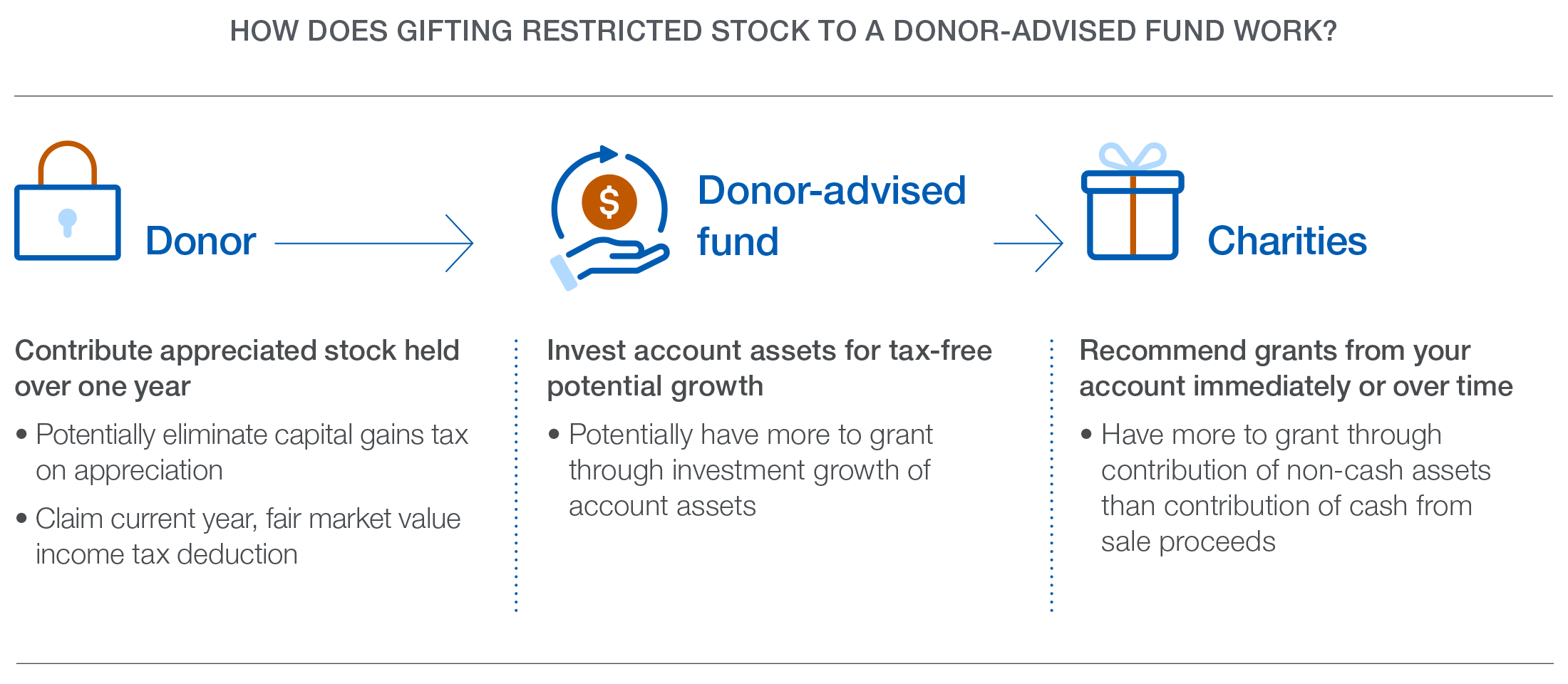
Donating restricted stock held more than one year can unlock additional funds for charity in two ways.
First, you potentially eliminate the capital gains tax you would incur if you sold the stock yourself and donated the proceeds, which may increase the amount available for charity by up to 20%. Second, you may claim a fair market value charitable deduction for the tax year in which the gift is made and may choose to pass on that savings in the form of more giving.
Donor-advised funds, which are 501(c)(3) public charities, provide an excellent gifting option for donations of restricted stock, as the funds typically have the resources and expertise for evaluating, receiving, processing, and liquidating the assets.
Disclosure: Please be aware that gifts of appreciated non-cash assets can involve complicated tax analysis and advanced planning. This article is only intended to be a general overview of some donation considerations and is not intended to provide tax or legal guidance. In addition, all gifts to donor-advised funds are irrevocable. Please consult with your tax or legal advisor.
What is restricted stock?
Restricted stock is stock that cannot be transferred or sold to the public—including by charities—until certain legal and/or regulatory conditions have been met.
At times, the restriction involves the removal of a “legend” that is placed on the stock itself. Stock is restricted by legend when it has not been registered with the Securities and Exchange Commission (SEC) under the Securities Act of 1933 or state securities law. At other times, the resale restriction may apply to the person (i.e., an Affiliate) attempting to transfer or sell “control” stock.
SEC Rule 144 provides an exemption to the SEC registration requirements and permits the public resale of restricted (legend) and control stock if a number of conditions are met, including how long the stock is held, the way in which it is sold, and the amount that can be sold in a certain time period. In addition to the restrictions described above, there may be additional restrictions placed on the timing of the transfer or sale (e.g., lock-up periods or closed trading windows).
For a donation of stock that is restricted by legend, and/or where you are considered an Affiliate (senior officer, director, or greater than 10% shareholder) of the company, your company’s general counsel must give permission for you to transfer the stock to a public charity, including a donor-advised fund. The charity then works with your company’s general counsel to remove the restriction. Please note that the donation process may require certain paperwork and filings, which can delay the timing of the stock transfer to charity.
Once the restriction is lifted, your stock may be donated to and sold by the charity. The charity’s sale allows you to potentially eliminate capital gains taxes and claim a current year, fair market value income tax deduction.
Important considerations when donating restricted stock
In addition to the potential tax benefits described above, the following considerations may apply.
1. Donate after restrictions are removed.
In order to maximize the potential tax benefits described above, you should transfer your appreciated restricted stock held for more than one year to a public charity, including a donor-advised fund, after working with that charity and your legal counsel to remove the restriction. Failure to remove the restriction prior to transfer may discount the valuation of your charitable deduction and require you to obtain a qualified appraisal from a qualified appraiser to substantiate the gift value.
2. Public charities generally may sell stock once restrictions are removed.
As discussed above, if your stock is subject to restrictive legend, and/or you are considered an Affiliate in the company, the company’s general counsel must give you permission to transfer your stock to charity. Also, the public charity will work with the company’s general counsel to satisfy requirements of Rule 144¹ to remove the restrictive legend. As explained, the contribution of restricted stock may require certain paperwork and filings.
Public charities are usually exempt from the ordinary notice, aggregation, and timing rules under Rule 144 as a non-affiliate of the company. This means that, once restrictions are lifted from the stock, the charity is generally free to sell the stock—with an exception for periods of time where the stock may be subject to lock-ups or closed trading windows, for example.
Case study: selling restricted stock vs. donating restricted stock
Michael, a senior executive at ABC Media, has been with the company since its founding and through its IPO. Michael has a highly appreciated stock position in ABC with a very low cost basis. His ABC stock awards are restricted by a legend, which must be removed prior to public resale (including resale by a public charity).
To save on taxes and support causes that are important to him, he has considered donating a portion of his ABC holdings to a donor-advised fund. In consultation with the donor-advised fund’s staff, Michael’s corporate counsel at ABC completes the necessary paperwork to lift the restrictive legend.
Explore how a direct contribution of stock to a donor-advised fund compares to a scenario where Michael sells the shares first and then donates the net proceeds to charity.
- Michael has $1 million of ABC shares with a $500,000 cost basis.
- Michael’s adjusted gross income (AGI) is $3.5 million, and his federal capital gains tax rate is 20%.
- Tax note: For taxpayers who itemize, only the portion of total charitable deductions for the year that exceeds 0.5% of AGI is deductible. In Michael’s case, this reduces his allowable deduction by $17,500 ($3,500,000 × 0.5%). See IRC § 170(b)(1)(I).
- Tax note: For taxpayers in the top tax bracket (above 37%), IRC Section 68 effectively caps the value of itemized deductions at 35%. In Michael’s case, this further reduces his tax-deductible amount as illustrated below.
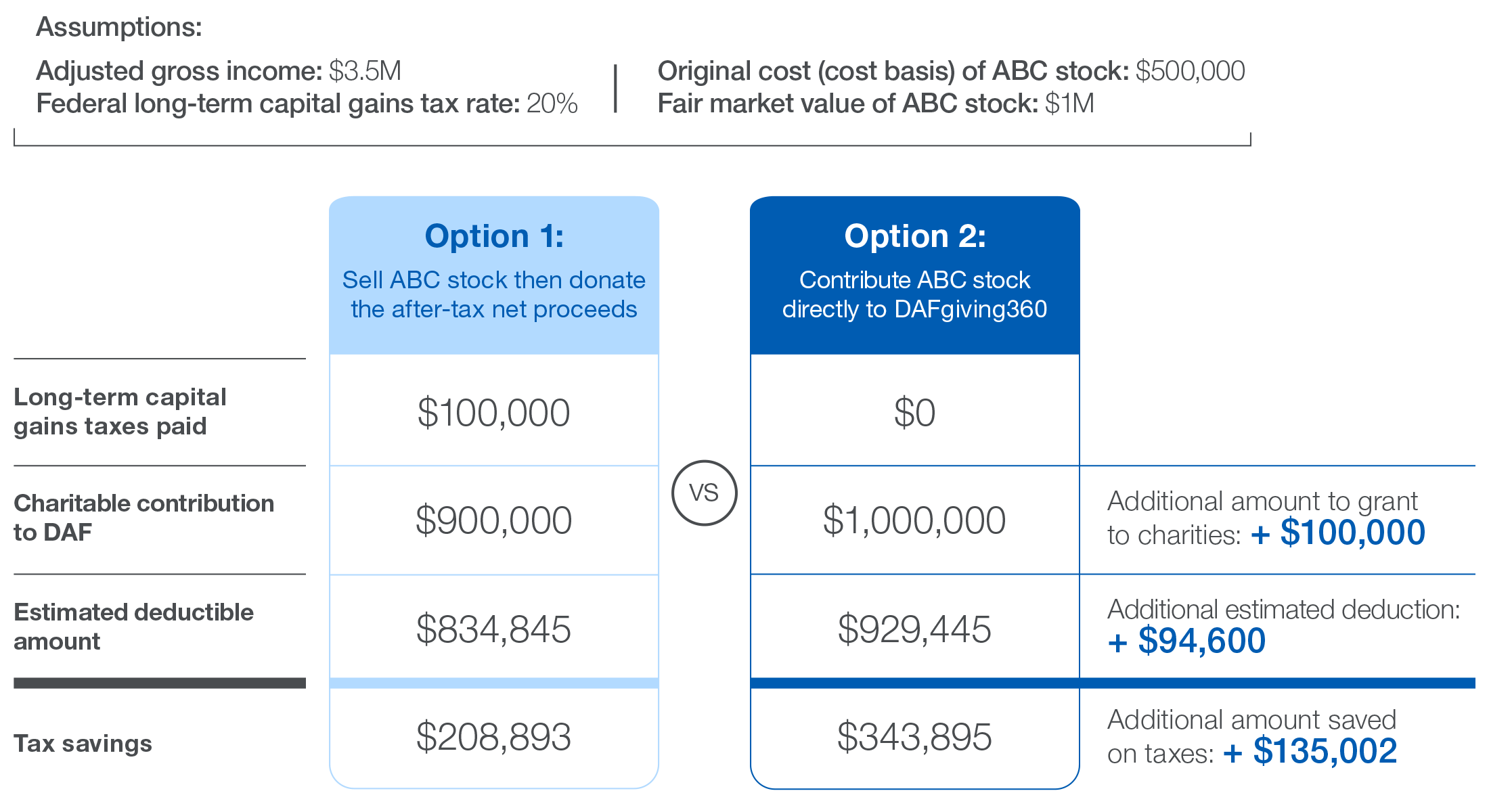
Option 1: Michael sells his stock first and then donates the net cash proceeds to charity. If Michael sells $1 million in ABC stock, he would owe an estimated $100,000 in federal capital gains taxes ($500,000 x 20%). After paying the federal capital gains taxes, Michael’s estimated net cash available for charitable giving is $900,000. After Michael donates the cash, Michael is eligible for an estimated tax deduction of $834,845. This reflects his $900,000 contribution, reduced by $17,500 (0.5% of AGI floor) and the $47,655 IRC §68 limitation.
Option 2: Michael donates his stock directly to a donor-advised fund or other public charity. Michael potentially eliminates $100,000 in projected federal capital gains taxes. This allows Michael to contribute the full $1,000,000 fair market value of ABC stock. After Michael donates the stock, Michael is eligible for an estimated tax deduction of $929,445, reflecting the $1,000,000 contribution reduced by $17,500 (0.5% of AGI floor) and the $53,055 IRC §68 limitation.² As a result, Michael has $100,000 more available to grant to charities and approximately $94,600 of additional deductible value.
This example is for illustrative purposes only. It does not take into account state or local taxes or Medicare and Net Investment Income tax. The estimate assumes a single charitable gift, no other itemized deductions, no carryforward and incorporates the 0.5% AGI floor, applicable AGI limits, and Section 68 reduction. The tax savings shown is the estimated deductible amount, multiplied by 37%, minus the long-term capital gains taxes paid. Gifts of restricted stock may require a qualified appraisal to determine fair market value. Actual deduction availability and tax benefits depend on individual circumstances and applicable limitations. Consult a tax advisor regarding your individual situation.
Gifts of restricted stock to charity are typically deductible, for those who itemize, at fair market value. Values may be subject to discount based on the specific restrictions if the restrictions are not cleared prior to contribution. In the above hypothetical case study, the restriction was cleared prior to contribution. No discount was applied to the deduction in this example because the restriction on the gift was cleared prior to contribution. The example assumes full deductibility (gifts to public charities, including donor-advised funds, of property held longer than one year are generally limited to 30% of AGI with a five-year carryover of any unused amount).
Interested in learning more?
- The Charitable Strategies Group at DAFgiving360 is a team of professionals with specialized knowledge about non-cash asset contributions to charities. Our team stands ready to support you and your advisors, from initial consultation through asset evaluation, receipt, processing, and sale. We strive to provide unbiased guidance and frequent communication at every step of the process to help you and your advisors make informed decisions and stay aware of the time required for your transaction.
- For more information about the advantages of contributing appreciated non-cash assets, you can read an overview article or call us at 800-746-6216.
- If you would like to learn more about donor-advised fund (DAF) accounts with DAFgiving360, click here.